What is Abdominoplasty?Abdominoplasty, also known as a tummy tuck or simply TT, is surgery to remove excess skin and fat on the abdomen that may accumulate after pregnancy, obesity, or age. In a full abdominoplasty, the abdominal muscles and connective tissue (or fascia) that may have become stretched out or lax over time are also tightened. In a mini-tummy tuck, only excess or redundant skin and fat are removed. A full tummy tuck may give you a new belly button to go with your new, taut stomach! Actually, although people say that the belly button is repositioned with a tummy tuck, it isn't. The belly button stays where it was and the skin is redraped around it. A hole is made through the redraped skin and the skin is then sutured around the original belly button. After the redraping, your abdominoplasty surgeon can adjust the size of the belly button with a bit of nipping and tucking. Tummy tucks are done on both men and women, but regardless of your gender, it is not a simple procedure. You must be aware of the risks and understand the amount of postoperative care that will be needed for recovery from tummy tuck. You will be laid up for at least 4 weeks after a full tummy tuck. It is not minor surgery. Indications for Abdominoplasty Surgery This laxness of the muscles and fascia can be corrected by folding the excess tissue and suturing it. Abdominoplasty can give you a tauter, slimmer waist and flatter abdomen. Rectus and rectus sheath cross-section ( click diagram for a larger image ) 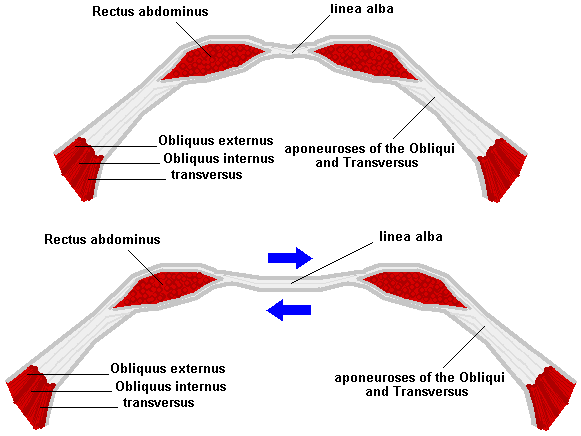
Some people may not need abdominoplasty with muscle repair and may benefit by liposuction to remove the fatty pooch of the abdomen. For some people who need more than liposuction but less than a full abdominoplasty, an endoscopic abdominoplasty may be an option. Am I A Candidate For Abdominoplasty? You must also be mentally and emotionally stable. This is an operation that requires patience and stability in dealing with the healing period. Recovery after tummy tuck can be tough. There is sometimes a lull or depression after surgery and if you already have an emotional problem, this low period can develop into a more serious issue. Please consider this before committing to the abdominoplasty surgery. An ideal candidate for abdominoplasty would have very elastic skin. But, of course, we human beings are never ideal. For that matter, if we had skin elasticity that good, we wouldn't need the abdominoplasty in the first place, now would we? Nonetheless, good elasticity certainly helps! Normally, women decide to have a tummy tuck after pregnancy has stretched out their abdomens. It is advisable to wait until you are finished having children before having a tummy tuck. Your skin and muscles can get stretched out again if you have a pregnancy after the abdominoplasty surgery. Similarly, if you are considering losing weight you should wait until after you reach your desired weight. If you lose more weight, you may need additional surgery to remove excess skin, which would mean that the money spent on the abdominoplasty would be wasted. Tummy Tuck Incision Placement and Scars Most surgeons try to use tummy tuck techniques that use the smallest incision possible and that leave scars in a place that will be covered by a standard bikini. However, the incision may need to be rather large or be placed higher for reasons outside of your surgeon's control. In most patients with moderate-to-severe redundant skin, there will be a need to create a new navel or move the existing one. Sometimes, the surgeon can perform the surgery using endoscopic techniques, which involves several short incisions. Be sure to discuss the incision types, techniques, and placements with your surgeon at your abdominoplasty consultation.
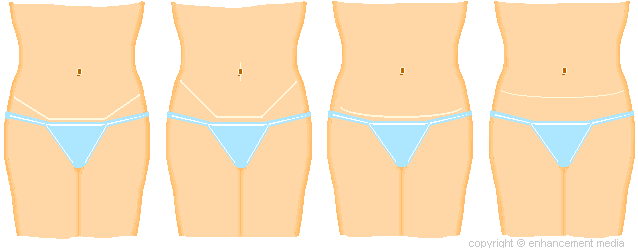
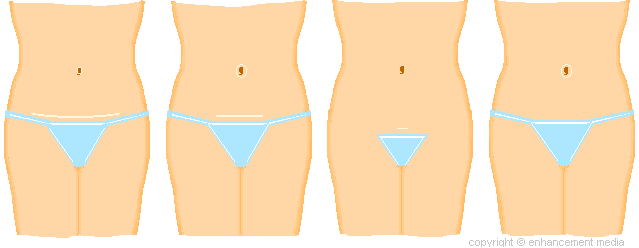 Tummy Tuck Techniques Overview There are several different types of abdominoplasty procedures. The type that is best for you depends on whether you need to have muscles tightened, skin tightened, fat removed, or a combination of any of those factors. Most surgeons do not perform every technique and some may try to 'one-size-fits-all' you for a sale. Be sure to determine all of your option Endoscopic Abdominoplasty Endoscopic surgery is performed using a small camera, called an endoscope, along with several surgical instruments that are inserted through two or more small incisions. The surgeon can tighten muscles and suture with the help of the endoscope. Liposuction can be done to remove fat and then the incision is closed. Although not as invasive as a full abdominoplasty, endoscopic abdominoplasty does require some recovery time and a surgical drain may be left in the incision for a few days. A drain is a small plastic tube that is left in an incision to prevent a build-up of fluid. When excessive fluid builds up and cannot drain properly, it can put pressure on the incision or cause other complications. A surgical drain can help prevent these problems. The tube usually empties into a small plastic bulb that looks a bit like a grenade. This bulb has to be emptied a couple of times a day, depending on how much fluid is draining out. Usually, drains are removed a few days after surgery, depending on how much fluid is draining out. Some studies found that endoscopic abdominoplasty was more beneficial for men with rectus abdominal diastasis than for women. However, man or woman, if you have generally taut skin, but loose muscles and fascia, you may be a good candidate for endoscopic abdominoplasty. Mini-Tummy Tuck; Partial or Modified Abdominoplasty Dermolipectomy Full Abdominoplasty Because a full abdominoplasty is so invasive, there is quite a bit of pain and swelling, as well as bruising. This is caused by the amount of tissue that needs to be removed or rearranged for a proper correction. However, everyone is different and not everyone will experience the same amount of discomfort. In a full tummy tuck, the surgeon makes an incision across your lower abdomen just above your pubic bone, usually from hip to hip. This incision is usually placed so that a bikini bottom will hide it. Skin and fat are loosened away from the abdominal muscles up to the bottom of the rib cage. An incision is also made around the belly button. Usually, all the skin and fat below the belly button is removed. Then, the fascia and rectus abdominus muscles are tightened by folding the fascia along the centerline of the abdomen. This brings the separated muscles together. The skin above the belly button is pulled down toward the pubic bone and sutured into position as the incision is closed. A new hole is made in the skin and the skin is sutured around the belly button. Usually, one or two drains are placed under the incision to allow fluids to drain for a few days. These drains usually exit through small incisions above your pubic bone. Reverse Abdominoplasty Vertical Scar Abdominoplasty; orFleur-de-lis Abdominal Liposuction Liposuction (also called lipoplasty, liposculpture, and suction-assisted lipectomy) is a surgical technique that removes fat through suction. An instrument called a cannula is inserted into a specific area through one or more short incisions. The cannula, which is attached to a suction device, is moved back and forth to break up deposits of fat that are then sucked out. Liposuction can be performed on the abdomen, flanks, the hips, the buttocks, the inner and outer thighs, above the knees, the upper arms, under the chin, and the neck. There are several different liposuction techniques, including tumescent, superwet, ultrasound-assisted, and power-assisted. You can find out more about liposuction and its benefits and risks at our sister website, Liposuction4you.com. If you are considering liposuction, you have to remember that it is not a substitution for a good diet and regular exercise. Liposuction should be used for those areas of stubborn fat that stay on you no matter how much you diet and exercise. |
